
Animation Legend Don Bluth And Phillip Glasser, Voice Of Fievel In ‘An American Tail’, Go Midwest To Feel Nostalgic At Fan Expo 2025

For many, the name Don Bluth evokes a flood of emotions that reaches all the way back to their earliest memories. The children of the 1980s were the first to get a taste of cartoons that defied the ‘safe’ standards set by Disney and Warner Bros. While the two titans of kid toons may have occasionally flirted with the dark side of storytelling, they would never pull viewers into the thick of it, and give them sights that would simultaneously enchant, distress, possibly traumatize, and pull at the strings of their young hearts for all time, but this changed when Bluth hit the scene.
After years of working at Disney in various animator roles, Don Bluth left in the early 80s to start his own studio, Don Bluth Productions. His directorial debut came in 1982 with the masterpiece The Secret of NIMH. Despite earning rave reviews, the film was a box office failure, and DBP had to shut down soon afterwards, but this was not the end for Bluth. Fate came knocking again when director Steven Spielberg (Jaws, E.T. The Extra-Terrestrial, Raiders of the Lost Ark) was looking to produce animated features, and he hired Bluth to create them.
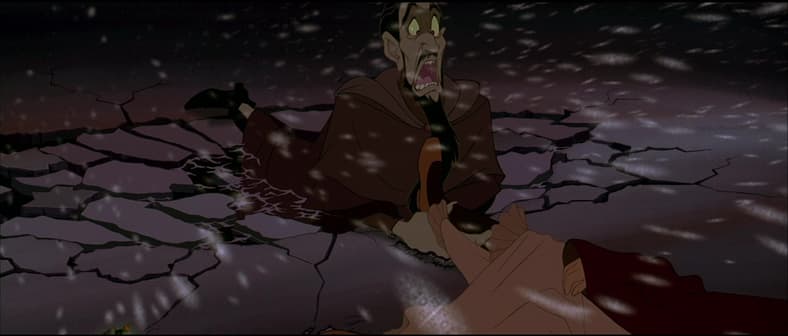
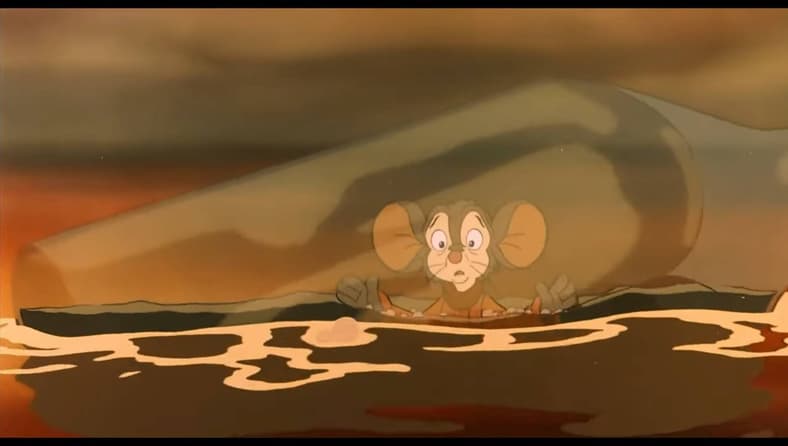
The duo collaborated on the beloved classics, An American Tail (1986), about a mouse named Fievel Mousekewitz who’s looking for his family, and The Land Before Time (1988), about young dinosaurs risking their lives to find The Great Valley. While Spielberg would take the reins of the two franchises after those inaugural films (and run them straight into the ground with a barrage of sequels), Bluth went on to direct other animated features such as the heart-wrenching All Dogs Go to Heaven (1989), the amusingly charming Rock-a-Doodle (1991), and the underrated gem Anatasia (1997).
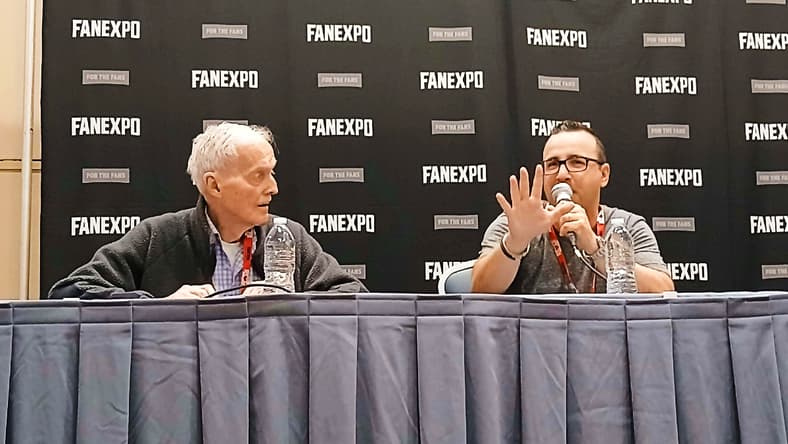
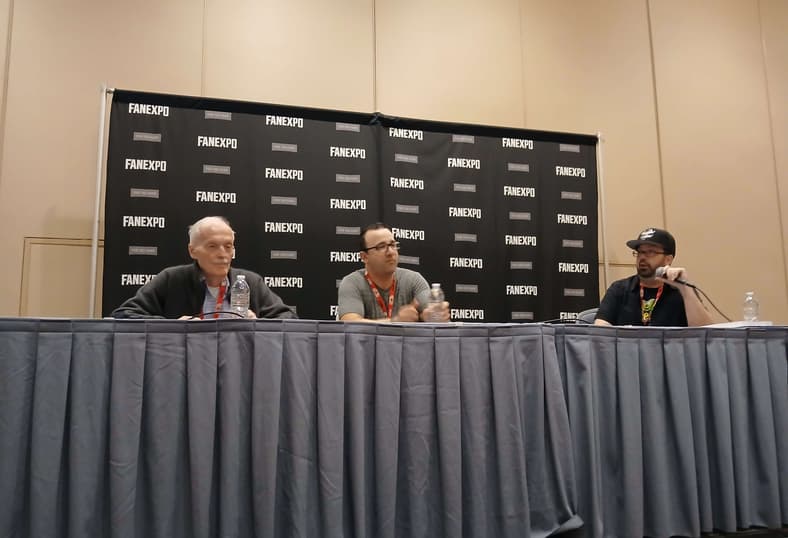
This is why Don Bluth and the voice of Fievel, Phillip Glasser, were greeted with a thundering ovation while taking their seats for the “Feel Nostalgic With An American Tail With Phillip Glasser And Don Bluth’’ panel during Chicago’s Fan Expo 2025 at the Donald E Stephens Convention Center last weekend with moderator Joe Deckelmeier. The first thing everyone wanted to know was how Phillip landed the role of the adorable Russian rodent.
“He was a selection after many, many voices,” Bluth said. “As I recall, Steven Spielberg said, ‘I’ll know when I hear the voice’. All of these cassettes came in, and we listened to all of them. There were a lot, maybe a hundred, and anyone I thought might be good, we’d send over the Spielberg. He listened to them and finally said ‘That one!’”
“I remember when he [Glasser] sang ‘Somewhere Out There’,’ he continued. “There was a moment where he had to hit a high note that his sweet little voice couldn’t quite reach [making it crack], and Steven said, ‘That’s him! That’s him!’ He [Spielberg] loved what Phillip did, and I think the general public did also. We can draw a mouse, and we can paint it different colors, but there’s something in the voice that makes it more adorable.”
Even though Glasser is most remembered for the role of “Philly” Mousekewitz, he also provided voice work for the ’80s cartoon series, Pound Puppies, and the popular ‘90s series, Tiny Toon Adventures, but a lot of people don’t know that he reunited with Don Bluth in 1994 for another feature film. However, it’s one that most fans choose to forget.
“It’s called a Troll in Central Park,” Glasser confided. “And I was honored to play the role of bratty older brother, Gus. It was really cool because we got to do it again, working with Don again, and I even got to sing another song. I was a little older this time and had a little more depth, but it was the same experience all over again. Working with Don always made it such a comfortable environment.”
A Troll in Central Park also marked the last time Don Bluth worked with his long-time collaborator, Dom DeLuise. He talked about how the late comedy actor would walk into the recording booth and immediately start going off-script with ad-libbed lines that were so good that Bluth would strike the intended lines out of the script and use Dom’s version instead. Bluth also talked about how Dom personally saved All Dogs Go to Heaven from potential disaster by the hands (or rather voice) of Burt Reynolds, and that he had hired DeLuise personally to work with him.
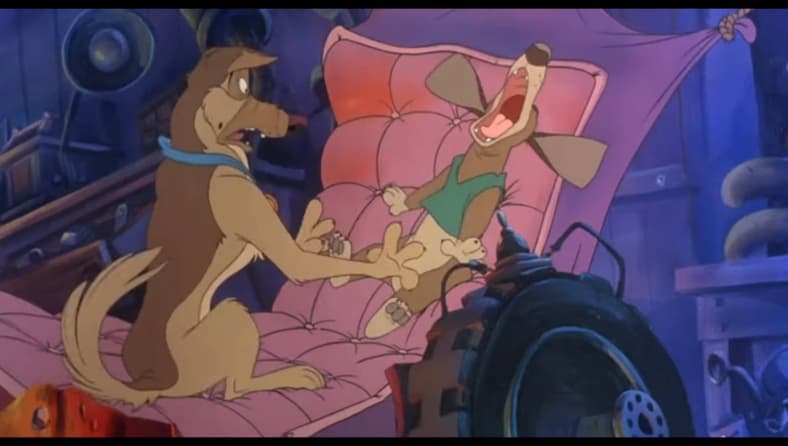
“When we were doing All Dogs Go to Heaven,” Bluth said, “Burt arrived onstage with a new ‘dog voice’ that he had invented. He started reading the script, and I went, ‘Uh, oh.’ It wasn’t good at all.”
That’s when Bluth called Dom, and told him that his friend, Burt, is determined that his terrible dog voice is perfect for the character of Charlie, and Dom immediately agreed to do the film so he could bark some sense into Reynolds. The famous twosome recorded their sessions at the same time, and side-by-side. According to the director, on the first day, Dom told Don to “just roll the tape,” and leave the rest to him.
“They started talking together,” Bluth stated. “And pretty soon, Burt started doing his dog voice. Dom [he chuckles before proceeding] stops everything and says, ‘Wait-wait-wait, Burt! What is that?!? You’re making a fool out of me! That is the stupidest sound you’ve ever made!’ He just told him off right there, and I was just grinning.”
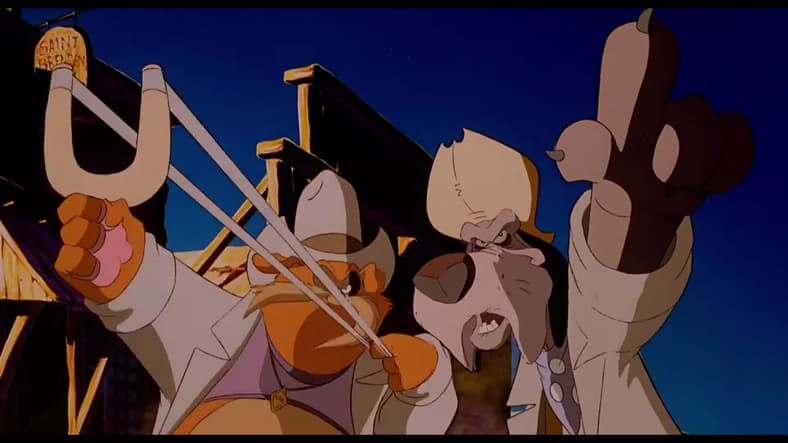
However, he wasn’t grinning when someone asked about An American Tail: Fievel Goes West. Glasser reprised his role in every sequel to the series while Bluth went on to other projects, but he didn’t mince words when discussing that movie, or the myriad of direct-to-video sequels of his other work.
“It [Fievel Goes West] didn’t have the same brilliance as Stephen’s first story.” He said. “They had the most gorgeous voice in the world, Jimmy Stewart, and everybody else was in there. So, you [the audience] will only watch it because of their voices.”
“There is no such thing as a good sequel,” he added, matter-of-factly. “I have a hard time with sequels. The Land Before Time TV sequels that go on and on, like cookie cutters.”
At almost 88 years old, Don Bluth shows no sign of slowing down. He has established an animation school called Don Bluth University, where he teaches online courses. Something which means a lot to him, and also eats up most of his free time.
“When you get to be my age,” he told the audience. “You begin to say, ‘Well, look, what can you leave behind besides a bunch of movies? Can you tell somebody how to make a movie, or how to draw, or how to find the gift that’s in them?’ I think that becomes really, really important; how to do it.”
On top of taking on the role of teacher, Don Bluth published his first children’s book in 2024 called Yuki: Star of the Sea. It’s based on his canceled film project from the 90s, The Little Blue Whale, which he described as an “Underwater Bambi”. The story was inspired by the Operation Breakthrough effort in 1988, an event which Bluth insisted that everyone in the crowd was “too young to remember” with a dismissive wave.
“The story is about a little whale who disobeys his mother, and he swims too close to the shore,” Bluth said. “He gets captured by a boat and taken into Mexico. So, now, he performs in a tank. It was very sad, and shouldn’t have happened, but he was disobedient.”
“But by the way, so was Fievel,” he concluded. “There was that scene [in An American Tail] where the father says, ‘Fievel, come back!’ while Fievel’s running towards the deck of the ship, and Fievel tells him, ‘No, father, I have to get my hat!’ Even though he had his hat on. Then he took it off, and threw it so he had to go get it. It was disobedience that set the course for the big adventure.”
Don Bluth’s autobiography Somewhere Out There: My Animated Life can be found on Amazon. An American Tail and The Land Before Time can both be rented through Prime. The Secret of NIMH is available for free on TUBI, and the same goes for All Dogs Go to Heaven.
