
Larian Studios Responds To ‘Divinity’ Generative AI Backlash: “We Use It As A Rough Outline For Composition Which We Replace With Original Concept Art”

After Larian Studios had been neck-deep in the AI debate – stating they were using it to “explore ideas”- the developer has confirmed it will no longer be using any AI or machine learning tools for concept art or writing in the upcoming Divinity.
Larian Studios’ CEO and co-founder, Swen Vincke, took on a Reddit AMA (Ask Me Anything) under r/Games. Amid the many asking questions and begging to know more about the new Divinity, one particular concern was put to rest.
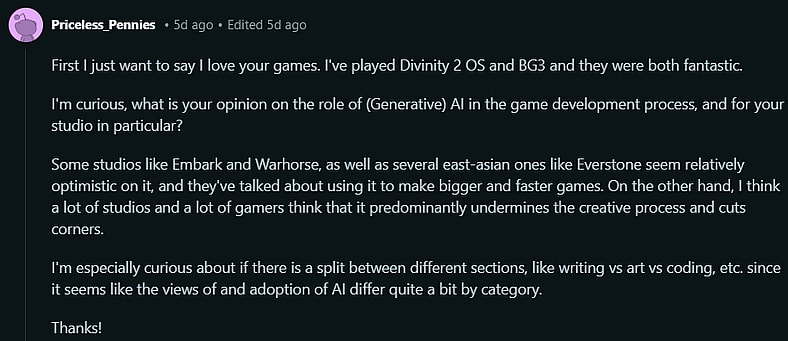
“First I just want to say I love your games,” Priceless_Pennies opened. “I’ve played Divinity 2 OS and BG3 and they were both fantastic. I’m curious, what is your opinion on the role of (Generative) AI in the game development process, and for your studio in particular?”
“Some studios like Embark and Warhorse, as well as several east-asian ones like Everstone, seem relatively optimistic on it, and they’ve talked about using it to make bigger and faster games. On the other hand, I think a lot of studios and a lot of gamers think that it predominantly undermines the creative process and cuts corners,” Priceless_Pennies compared.
“I’m especially curious about if there is a split between different sections, like writing vs art vs coding, etc., since it seems like the views of and adoption of AI differ quite a bit by category. Thanks!”
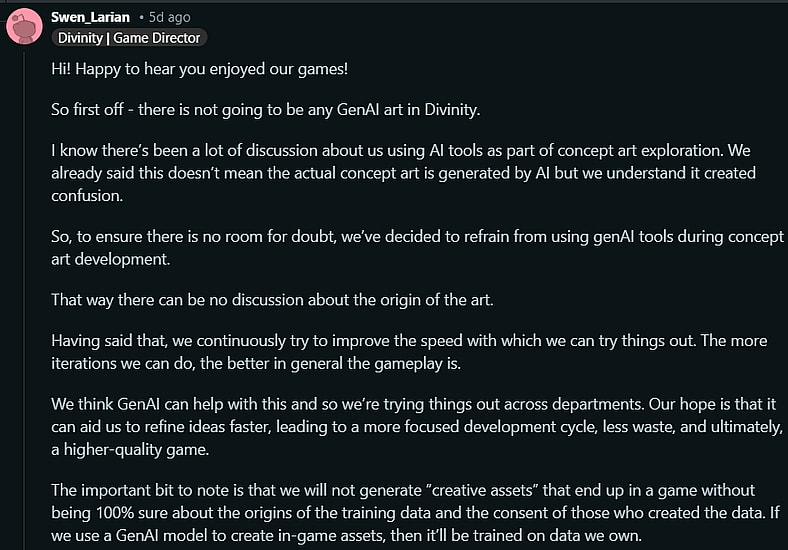
Vincke wasted no time: “Hi! Happy to hear you enjoyed our games! So first off – there is not going to be any GenAI art in Divinity.”
“I know there’s been a lot of discussion about us using AI tools as part of concept art exploration. We already said this doesn’t mean the actual concept art is generated by AI, but we understand it created confusion. So, to ensure there is no room for doubt, we’ve decided to refrain from using genAI tools during concept art development,” Vincke revealed.
“That way, there can be no discussion about the origin of the art.”
Nonetheless, Vincke shared, “Having said that, we continuously try to improve the speed with which we can try things out. The more iterations we can do, the better in general the gameplay is.”
“We think GenAI can help with this, and so we’re trying things out across departments. Our hope is that it can aid us to refine ideas faster, leading to a more focused development cycle, less waste, and ultimately, a higher-quality game.” Those concerned about Vincke contradicting himself may not need to worry.
“The important bit to note is that we will not generate ‘creative assets’ that end up in a game without being 100% sure about the origins of the training data and the consent of those who created the data. If we use a GenAI model to create in-game assets, then it’ll be trained on data we own,” Vincke shared.
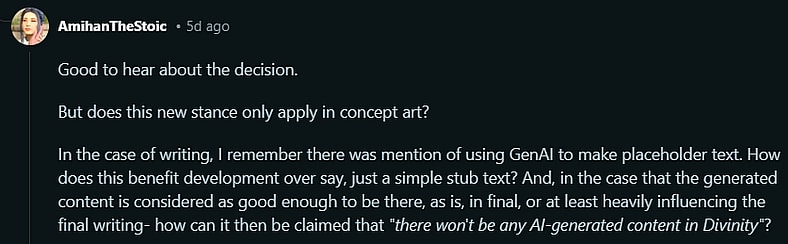
Amid praise from the other users, other members of the Larian staff elaborated on follow-up questions. “Good to hear about the decision,” AmihanTheStoic cautiously praised, “But does this new stance only apply in concept art? In the case of writing, I remember there was mention of using GenAI to make placeholder text.”
“How does this benefit development over say, just a simple stub text? And, in the case that the generated content is considered as good enough to be there, as is, in final, or at least heavily influencing the final writing- how can it then be claimed that ‘there won’t be any AI-generated content in Divinity‘?” they continued.
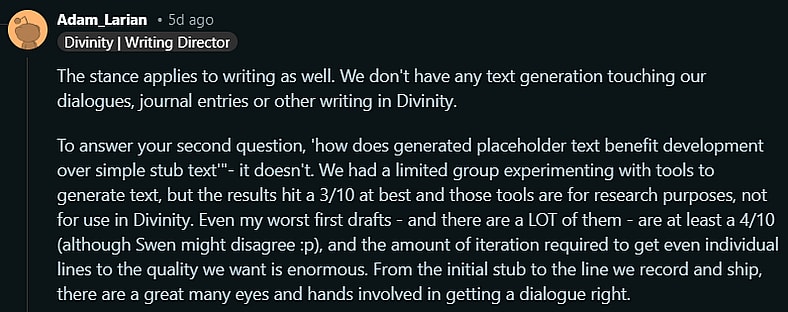
Writing Director Adam Smith tried to put concerns to rest. “The stance applies to writing as well. We don’t have any text generation touching our dialogues, journal entries or other writing in Divinity.”
“To answer your second question, ‘how does generated placeholder text benefit development over simple stub text’- it doesn’t. We had a limited group experimenting with tools to generate text, but the results hit a 3/10 at best and those tools are for research purposes, not for use in Divinity,” Smith assured.
“Even my worst first drafts – and there are a LOT of them – are at least a 4/10 (although Swen might disagree :p), and the amount of iteration required to get even individual lines to the quality we want is enormous. From the initial stub to the line we record and ship, there are a great many eyes and hands involved in getting a dialogue right,” Smitch championed.
TraditionalJob7651 demanded to know the exact details of Vincke’s promise. “I have a couple more questions from reading this:
“1. You mention that you’ll use a GenAI model trained on data you own for game assets, is this the case (using a personal model) for everything else? If not, how so? What’s an example of an in-game asset that could be generated by AI? (haven’t understood the distinction between creative asset and just Regular Asset here),” TraditionalJob7651 admitted.
“2. Can you give examples of the uses for GenAI across departments ‘to refine ideas’?”
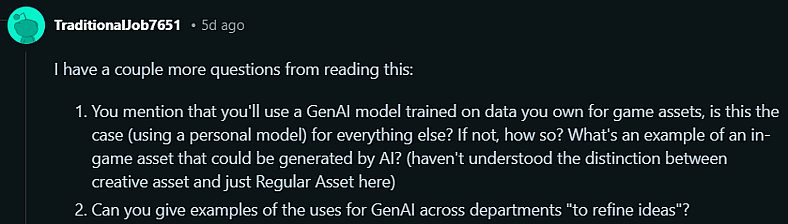
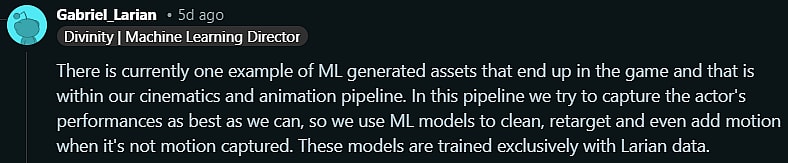
The answer came from the Machine Learning Director, Gabriel Bosque. “There is currently one example of [ML-generated] assets that end up in the game and that is within our cinematics and animation pipeline.”
“In this pipeline we try to capture the actor’s performances as best as we can, so we use ML models to clean, retarget and even add motion when it’s not motion captured. These models are trained exclusively with Larian data,” Bosque reiterated.
The attention over AI in Larain’s case is understandable, due to a controversy that boiled over within one day.
After their reveal at The Game Awards 2025, Vincke stated in an interview with Bloomberg’s Jason Schreier that while Divinity won’t have AI-generated content (“everything is human actors; we’re writing everything ourselves”), in Schreier’s words, “the creators often use AI tools to explore ideas, flesh out PowerPoint presentations, develop concept art and write placeholder text.”
While this led to some rejection at Larain, Vincke stated, “[But] I think at this point everyone at the company is more or less OK with the way we’re using it.”

Gamers were not OK with how they were using it, however, especially as discussions of AI replacing employees in fields that require creativity, originality, and innovation. Even former staff came out in strong rejection.
Vincke justified the studio’s direction in a statement issued to IGN, “We’ve been continuously increasing our pool of concept artists, writers, and [storytellers], are actively putting together writer rooms, casting and recording performances from actors, and hiring translators.”
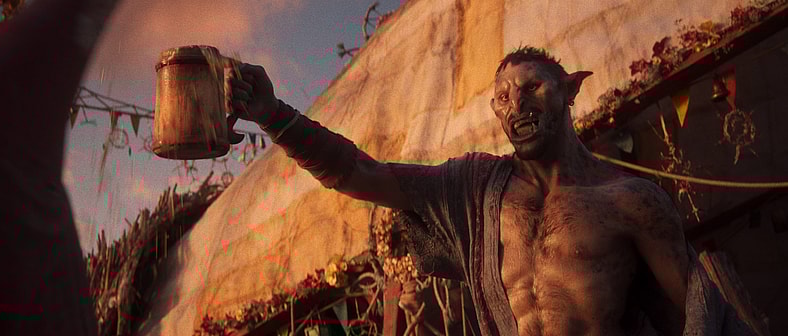
“Since concept art is being called out explicitly – we have 23 concept artists and have job openings for more. These artists are creating concept art day in day out for ideation and production use. Everything we do is incremental and aimed at having people spend more time creating,” Vincke highlighted.
Vincke insisted “Any ML [Machine Learning] tool used well is additive to a creative team or individual’s workflow, not a replacement for their skill or craft. We are researching and understanding the cutting edge of ML as a toolset for creatives to use and see how it can make their day-to-day lives easier, which will let us make better games.”
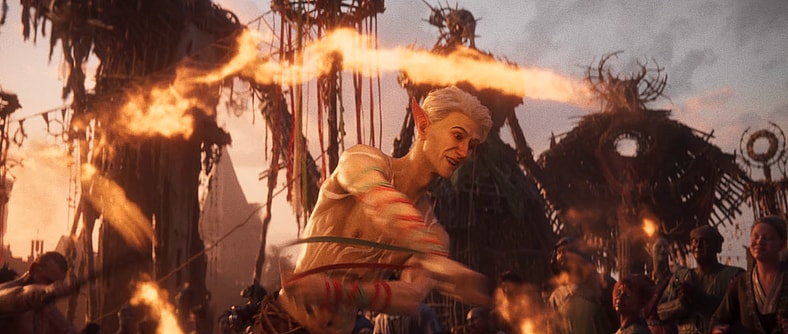
“We are neither releasing a game with any AI components, nor are we looking at trimming down teams to replace them with AI. While I understand it’s a subject that invokes a lot of emotion, it’s something we are constantly discussing internally through the lens of making everyone’s working day better, not worse.”
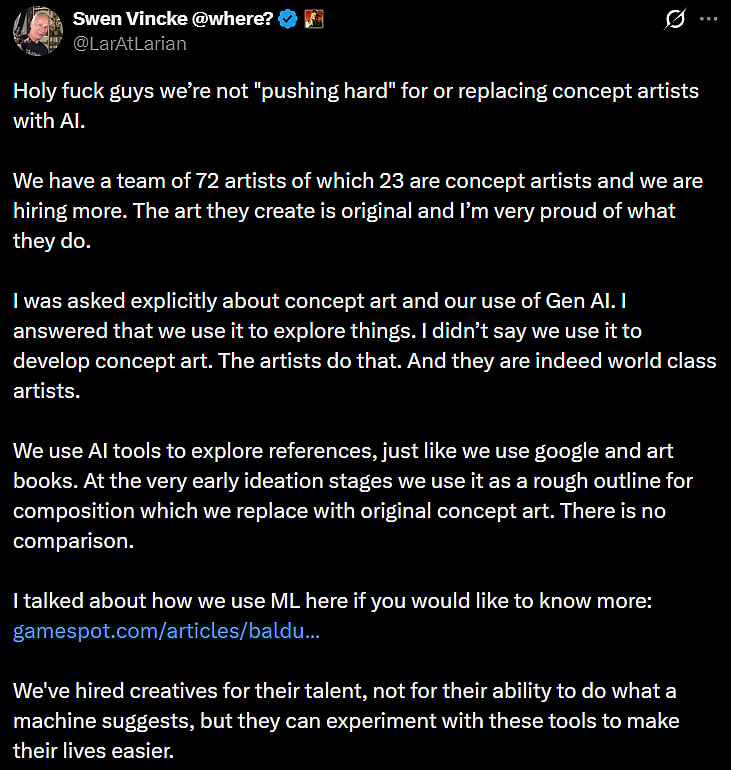
Despite this statement, the pressure seemingly got to Vincke. He tweeted, the same day the Bloomberg interview was published, “Holy f–k guys we’re not ‘pushing hard’ for or replacing concept artists with AI. We have a team of 72 artists of which 23 are concept artists and we are hiring more. The art they create is original and I’m very proud of what they do.”
“I was asked explicitly about concept art and our use of Gen AI. I answered that we use it to explore things. I didn’t say we use it to develop concept art. The artists do that. And they are indeed world class artists,” Vincke defended.
“We use AI tools to explore references, just like we use [Google] and art books. At the very early ideation stages we use it as a rough outline for composition which we replace with original concept art. There is no comparison,” he insisted.
Vincke linked to his interview with GameSpot over using machine learning being used on Baldur’s Gate 3 for tasks “nobody wants to do.” “We’ve hired creatives for their talent, not for their ability to do what a machine suggests, but they can experiment with these tools to make their lives easier,” Vincke justified.
While Larian Studios has changed its stance, it seems likely debate on if and how to use AI in game development will rage on within every studio.
