
Sony Developing New Censorship AI Capable Of Making Real-Time, On-Demand Edits To Any Media On Any Platform


In the latest confirmation that the world’s corporate oligarchy will always care more about money and power than their actual customers, a new patent filing has revealed that Sony is currently working on a new AI model that will allow for the censorship of any media, including movies, video games, and even internet uploads, in real-time.

RELATED: Sony CEO Says ‘No’ To Buying Warner Bros. Discovery, Would Rather Focus On “Global Market For Anime”
The brainchild of current PlayStation Global User Experience Design lead Mason Foster, details as to this worrying new tool were first brought to light courtesy of a December 9th patent application to the United Nations’ official World Intellectual Property Organization (WIPO), as filed under the title “Automatic Bespoke Edits of Video Content Using AI”.
Explaining their reasoning behind the AI’s creation, Sony asserted, “As recognized herein, ratings levels for video games and other types of audio video (AV) content can evolve over time in that certain types of potentially sensitive content may become more acceptable and therefore qualify the AV content for a lower rating than it might have received in the past.

“Given this, it is difficult for parents and guardians to adequately judge the nature of the AV content prior to letting their children watch or play it. But more than that, the general ratings themselves might not adequately compensate for individual user sensitivities to certain things that might be objectionable to a specific person for whatever reason. Current technology fails to provide a way to adequately address these things.”
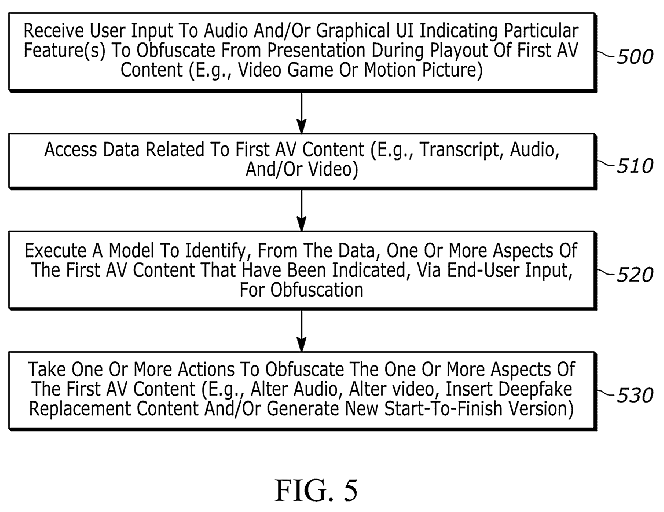
To this end, the AI will allow for the “vetting of audio video (AV) content, audio-only content, and/or video-only content for language, sexual situations, drug use, violence/gore, etc., and even for individual user sensitivities to certain types of content that might not be otherwise be objectionable to others. The content itself may include movies/motion pictures, video games, user-uploaded videos streamed over the Internet, content provided by third-party streaming services, etc. [and] may also apply to text/written content such as books and Internet website content as well.”
“Accordingly, users [will be able] to set custom, nuanced, user-specific parameters for content that the user does not wish to observe. An AI model can then process a bespoke cut of the AV content on the fly, skipping or muting any offending parts according to the user’s own parameters. Thus, fast-forwarding may be used, as may muting of the objectionable content, pausing before playout of the objectionable content, etc.”
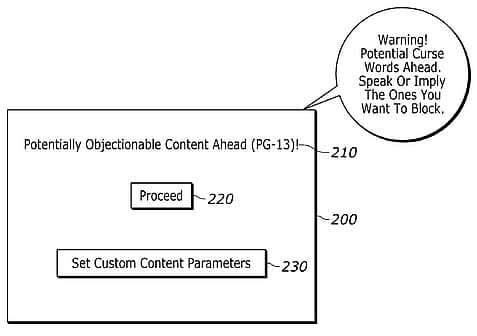
Providing some examples of how this AI would work, Sony detailed, “A person might specify that the four-letter ‘S’ curse word is acceptable for playout but the four-letter ‘F’ word is not. The user might also specify that only implied nudity is acceptable while actual nudity is not, and that alcohol use is acceptable but hard drug use is not. The user might also have a problem with clowns and red balloons, and can therefore specify that no clowns or red balloons should be shown in any AV content. These types of things may be input not just by parents of children, but also for general audience users who might want to enjoy content while avoiding things to which they are sensitive or otherwise do not wish to see.
“Thus, despite the fact that what a society may consider sensitive in nature or even taboo might change over time, and hence change what content ratings (like R ratings and PG-13 ratings) might be assigned to a given piece of content, present principles provide technological advances that address this issue and allow dynamic, on-the-fly content alteration to address the user’s specific content preferences.”

Turning to the AI’s specific mechanics – and here’s where it goes from ‘worrying’ to straight up dystopian – Sony detailed how “potentially objectionable content can then be dubbed over or otherwise altered, such as by using deepfake technology to replace the objectionable content with other content in the same audible voice and in the same visual appearance as the originator (within the AV content) of the objectionable material itself.”
“Additionally or alternatively, an image or word in the content can be obfuscated/replaced other ways based on a computer-based video analysis of the content to flag input words from the user. Censor bars may also be used, as may pixel blurring or removing/clipping AV sections that contain the objectionable content.”
In addition to directly editing the content, Sony also proposes a support ‘censorship warning system’ that will have the AI “tell the player/viewer ahead of time before the objectionable content is presented so the player/viewer has the option to tell the AI system what to do”.
Further, “the system may prompt the user once the AV content starts, e.g., based on the system accessing known summaries for the relevant content once the system knows the user is about to watch/observe it. Thus, either before content presentation starts or in the middle of playback, the user can indicate for example that ‘no red balloons’ should be shown, and then the system can overlay a text box over any red balloons in the content that says ‘no red balloons’, or even prompt the user before playout of the red balloons that indicates ‘Red balloon coming up, I’ll beep cell phone or display a picture-in-picture (PIP) message to cover the kid’s eyes.'”
“The system may then control the connected cell phone and/or present a PIP message over the red balloons themselves during playout of the red balloons as presented on the display. Thus, the filters may be user-specific based on whatever content the user wants to flag, rather than merely having generic classifications for ‘foul language’ or ‘violence’ without more.”
And in putting the cherry on top of this digital sh*t sundae, rather than being developed exclusively for use on Sony and PlayStation’s own media, the AI has instead been developed for a wide-use “either as part of a television’s or video game console’s operating system or even as part of a stand-alone app”, with given examples including “a Sony PlayStation® or a game console made by Microsoft or Nintendo or other manufacturer”, “virtual reality (VR) headsets”, and various “mobile devices”.
At present, Sony has yet to have their patent application either accepted or denied, which means the actual deployment of their real-time censorship AI is still a ways away.

However, do not think for one second that any amount of player backlash or bargaining will get them to back track on this technology, as corporate greed will always lead major players like Sony to try and clean up their offerings for mass public consumption by any means necessary – even actively causing psychosis within a massive portion of the human population.
