
Former Capcom Designer Asks Players Not To Support ‘Palworld’ Amid Legal Battle With Nintendo

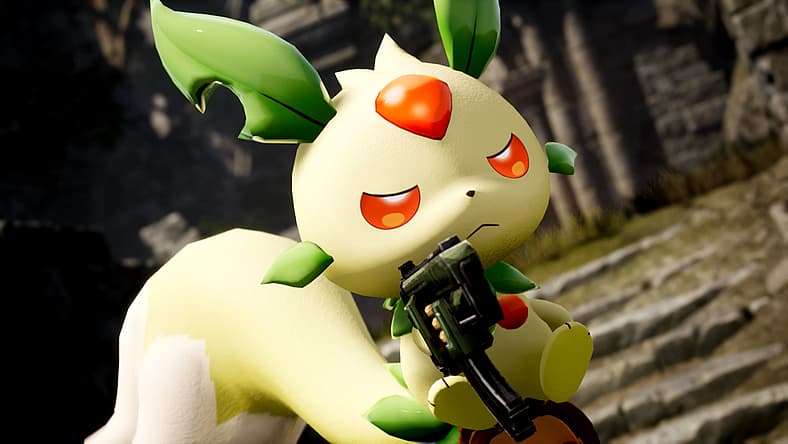
Yoshiki Okamoto (who has worked on Final Fight, Street Fighter, Mega Man, Resident Evil) has drawn ire after weighing in on the Nintendo vs. Pocketpair patent lawsuit. He argues Palworld had “crossed a line,” and due to the lawsuit asked his viewers not to buy the game.
Western viewers deemed his assessment unfair, perceiving Okamoto’s comments as support for Nintendo (seen as the aggressor employing unfair tactics). Similarly, Japanese viewers felt his comments comparing Pocketpair to criminals went too far.
RELATED: ‘Final Fantasy VII Remake’ Director Says Third Game Won’t Launch With Streamlined Progression Mode
In the video (“auto-dubbed” by YouTube, though inaccurate at times, and with further translation by Verity Townsend of IGN) Okamoto discusses how Palworld will officially launch next year, along with his own gripes.
He feels it’s a game that “crossed a line that should not be crossed, and I don’t want the world to become a place where this kind of thing is acceptable” — nor should anyone be granted exception if they “win confidently,” sell well, make something fun to play, or something that gets good reviews.
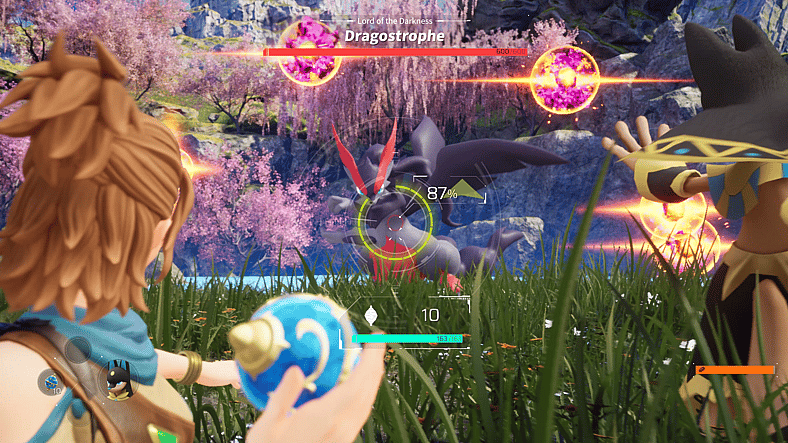
Okamoto was also surprised the game launched, thinking it would remain “in beta” forever while being widely played. This led him to speculate that Pocketpair had made some kind of deal with Nintendo over the patent lawsuit; as though they wouldn’t move ahead with the launch without settling that case first.
He emphasized he had no information to confirm this suspicion, and it was just his opinion.
Okamoto also theorized Pocketpair’s major update for the official launch will change more elements to avoid the patent lawsuit, even if it changes Palworld into a very different game, or otherwise “trying to get their foot off the landmine they were stepping on.”
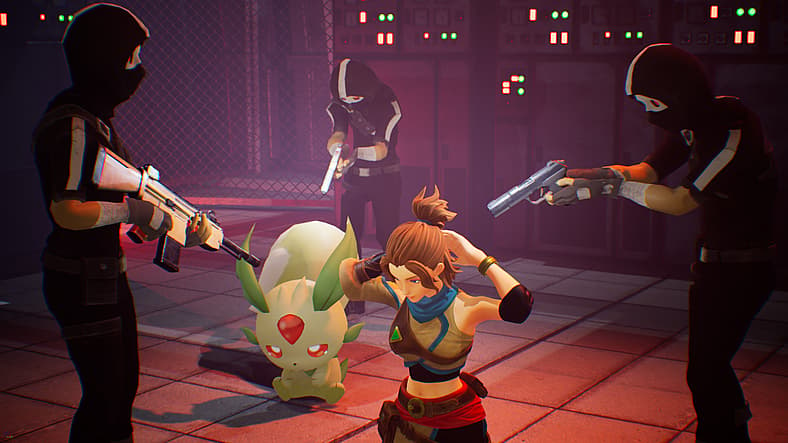
RELATED: Female MC Not Being Added As ‘Persona 3 Reload’ DLC, Devs Want To Focus On “New Projects”
Okamoto also explained while he hadn’t played Palworld to form these opinions, he had no intention to buy or play it either — despite the fact having “haters” along with fans means you are “established.”
Returning to his theory that a secret deal had been made with Nintendo, Okamoto explained “if a settlement is reached with Nintendo, then I think it will become a game that is officially fine to play. However, it is currently a game that’s being sued so it’s unacceptable. By playing the game you are supporting it, so please don’t buy it.”
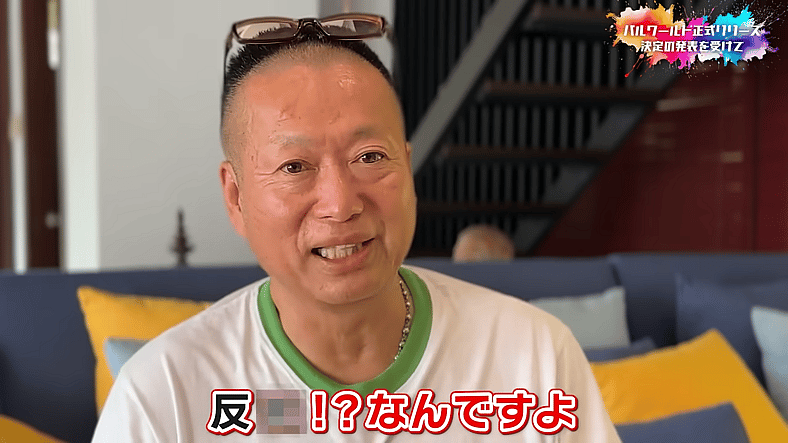
Of note is the fact part of a caption was censored at this time. Townsend translate the censored element as “anti-xxxx,” proposing it stated “anti-social force.” Social force being “hansha” a term for organized crime and other groups that do things in an illegal or improper manner.
Okamoto concluded that it would be better to wait for the lawsuit to conclude, before anyone should buy Palworld, and that Pocketpair winning the case could embolden those who want to make imitations of Mario, Zelda, and “everything Nintendo has worked hard to create.”
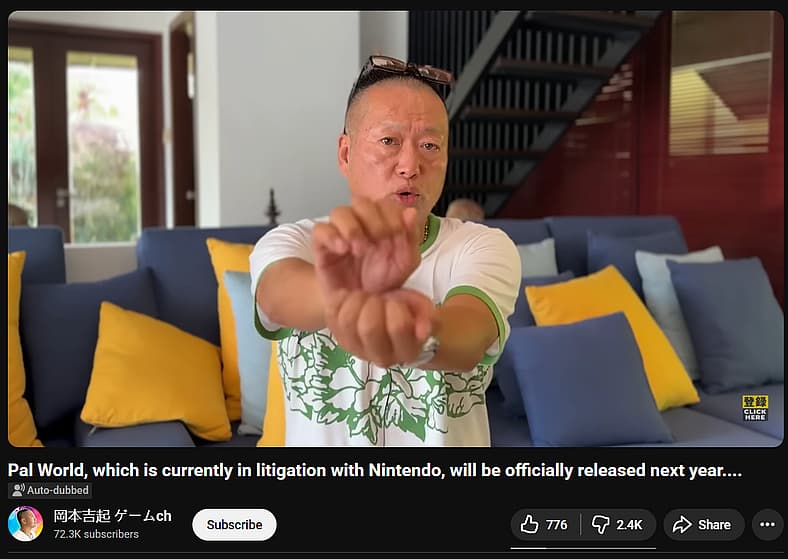
Okamoto’s opinion gathered some criticism. Using third-party plug-ins to display the number of likes and dislikes, his video currently has 774 likes and 2,400 dislikes at this time of writing. As Townsend reports, several Japanese comments were against Okamoto’s use of the anti-hansha term as being too harsh, and highlighted him asking others to be respectful and polite ran counter to his own video.
Some Japanese comments even noted his comments could be considered defamation.
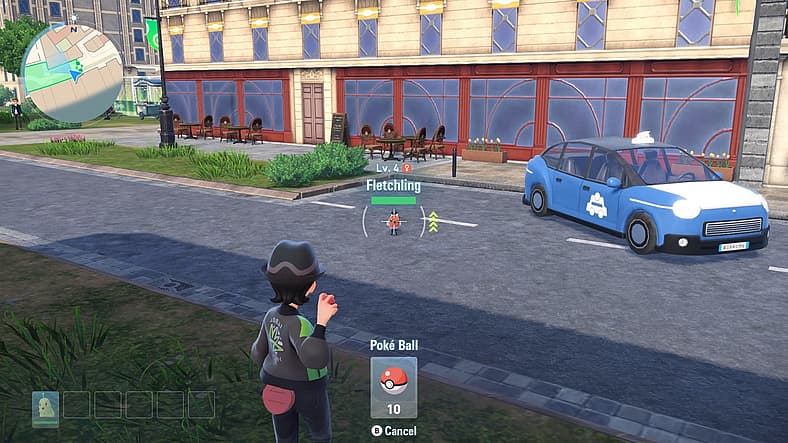
Meanwhile, comments from western viewers objected to the notion of not buying a work just because Nintendo — in their minds, unfairly — had taken Pocketpair to court. Especially after Nintendo’s patents had become wider-reaching, and allegdly attempting to modify them to make their case against Pocketpair easier.
RELATED: Sonic Team Says No To ‘Sonic Adventure’ Remakes – But SEGA Could Still Make It Happen
As previously reported, Western and Japanese gamers have different attitudes to fair use and copyright. Summarizing the explanation by attorney and YouTuber Moon Channel, Japanese law is stricter with their IP (effectively having no “fair use”), which allows them more ease to strike down those who infringe too much, and making it easier to protect the IP.
Paradoxically, this allows a lot of “low level” infringement in Japan (doujins and fan-works), as companies have less to fear from their existence. The US meanwhile needs to be more aggressive, even on smaller works, to protect their IP as fair use is trickier to define, and they risk losing ownership if they do not defend it sufficiently.
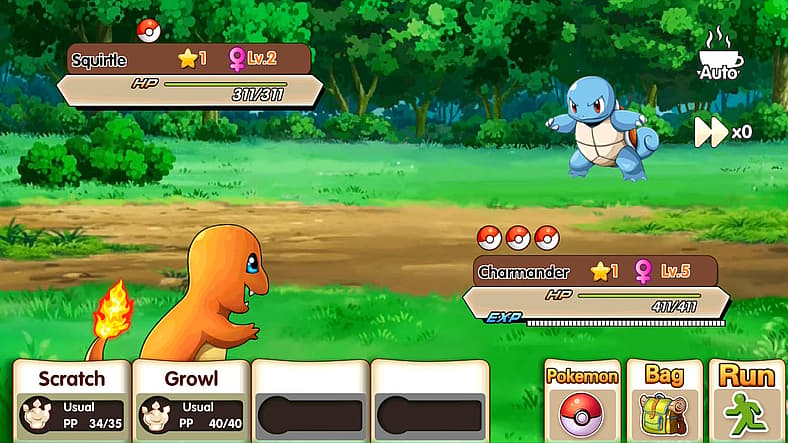
Japanese law translates into the relationship between creators and consumers in Japan. The “unspoken agreement” (as Moon Channel puts it) is for fans to self-police fan and self-published works, so only projects that get “too big” are taken down, rather than all the others.
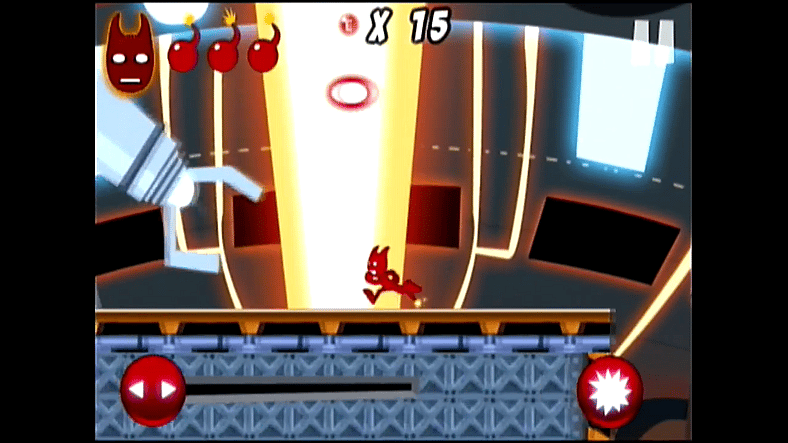
Hence, Japanese consumers — and Okamoto — see Palworld as going too far. Much like how indie platformer ‘Splosion Man was ripped off by Capcom’s MaXplosion in 2011. It should be noted the title was released long after Okamoto had left the company in 2003, and Capcom was reportedly “saddened by this situation.”
RELATED: ‘Saints Row’ Dev Claims THQ Nordic Threw Out Original Plots, Forced Changes To “Misogynistic” Dialogue
It should also be noted during the September Nintendo Direct, Capcom showed off footage of Monster Hunter Stories 3: Twisted Reflection. The player can be seen riding and switching between Monsties; something that could be considered similar to the “smooth switching” mount mechanic that Nintendo patented, and one of three they are suing Pocketpair over.
Industry analysts have previously explained that while Nintendo have many patents, they only use them when they feel threatened by competition. Does Nintendo see Capcom as too big a battle to win, or not able to put a dent in Pokémon?
Okamoto is best known for his work as a Producer on Final Fight, Street Fighter II (and several other titles in the series), Night Warriors: Darkstalkers’ Revenge, several Mega Man titles, and Supervisor on several Resident Evil titles.
In 1997 he left Capcom to form Flagship, though continued making titles for Capcom through that company. He would truly leave Flagship and Capcom around 2003, forming Game Republic that year, creating the Genji series. One could arguably make comparisons to Capcom’s own Onimusha and Devil May Cry series.
After Game Republic shut down in 2011, Okamoto would go on to work for Mixi (Monster Strike), and became the chairman of the Japan Game Culture Foundation in 2017.
