
‘Final Fantasy VII Remake’ Director Says He Understands Nintendo Switch 2 Game-Key Cards Concerns, Still Prefers New Format Over Traditional Cartridges

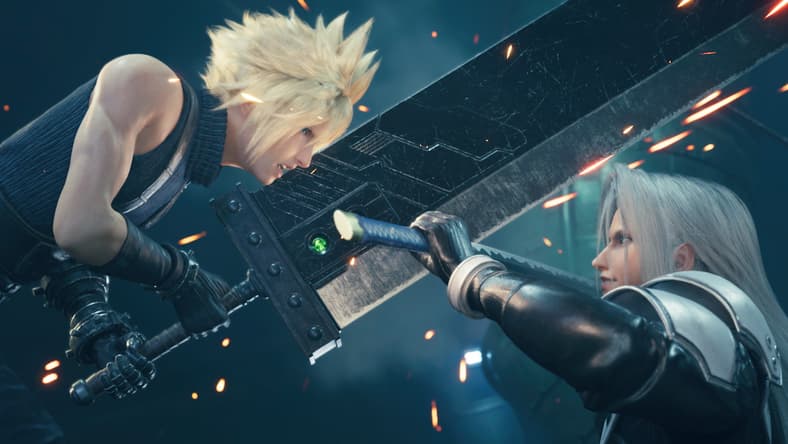
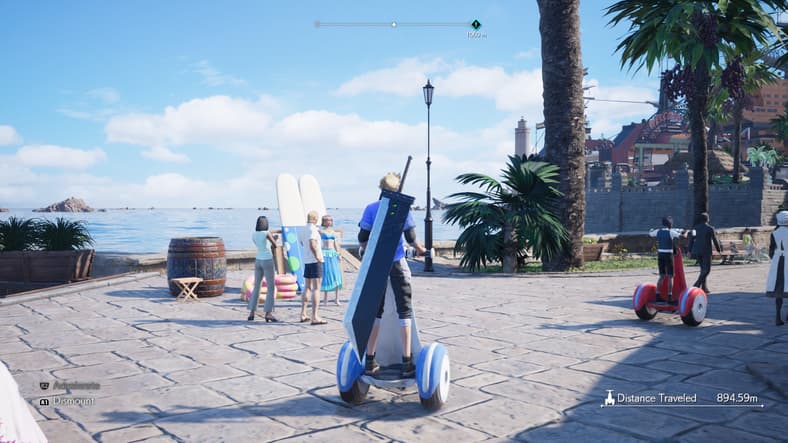
Naoki Hamaguchi, director of Final Fantasy VII Remake, has recently stated that developers are irked by the slow loading speed on Nintendo Switch 2 carts. This led to them using the controversial Game-Key Cards.
RELATED: Gameplay Trailer For Insomniac Games’ ‘Marvel’s Wolverine’ Reveals Fall 2026 Launch Window
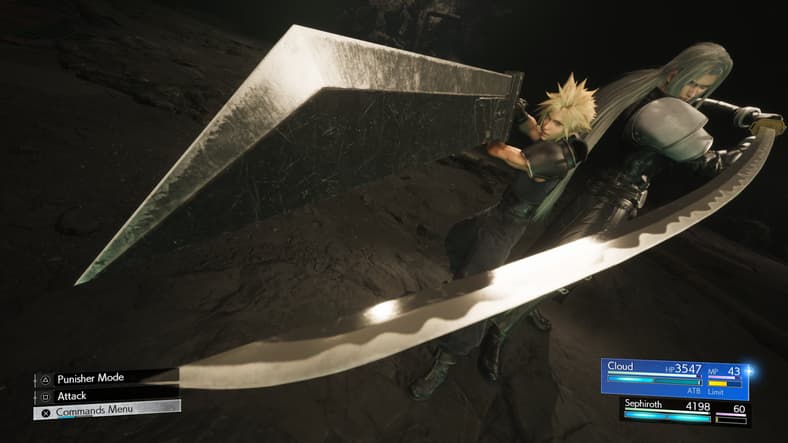
Speaking to JP Games.de (translation provided by them), Hamaguchi was asked about the upcoming Nintendo Switch 2 version of Final Fantasy VII Remake. “Mr. Hamaguchi, most of our readers grew up with Final Fantasy and physical media like CD ROM and cartridges, and many are still attached to them,” JP Games’ “Tony” opened.
“It’s understandable that Final Fantasy VII Remake Intergrade couldn’t be optimized for a 64GB cartridge for Switch 2. We’re excited about the reversible cover and the Magic Booster, though! Are you aware of the criticism of game key cards, including within the company?” Tony inquired.
“Yeah, I have heard the reaction that the various Nintendo gamers have towards the key card,” Hamaguchi admitted. “I understand where they’re coming from, definitely. I can see the things that they are maybe annoyed with, maybe why they don’t like it, and I get that, I really do.”
He then revealed, “But certainly, among developers, the discussion about the key card format is perhaps a bit different to what the fans maybe expect.”
“It’s always, I think, looked at in terms of the memory restrictions, and that is an issue, that’s not something we can ignore, the fact that the standard cartridge, like you say, has a smaller memory, and we have to work around that,” Hamaguchi explained.
RELATED: ‘Vampire: The Masquerade – Bloodlines 2’ Puts DLC Clans In Base Game After Outcry
The size of physical Nintendo Switch 2 carts was only an aside however.
Hamaguchi continued, “But I think perhaps the biggest issue for developers, certainly for people like us who make high-end HD games, is the loading speed, because you compare that to the solid-state drive and the speed you can get from loading from that, it’s going to be inferior to that, it just has to be, that’s the way the media works, physically.”
“So that’s the bigger issue, really, in terms of making games, making high-end games for the Switch 2, and what it allows, obviously, by doing a semi-download version of the game, you can then use the SSD and rely on that for that smoother loading. So that’s perhaps the bigger issue in terms of a developer,” Hamaguchi revealed.
“This is just my personal thoughts about this, but I kind of like, if possible, maybe Nintendo fans to understand the key cards and maybe come to accept it as part of the culture of gaming on Switch, because it allows more opportunities,” Hamaguchi proposed.
“It’s an option, it’s not that everyone has to use it, but it’s another option to deliver the games to fans, and I think we could lose out on opportunities, there may be people, if we didn’t have that option, who wouldn’t get to play the game,” Hamaguchi insisted.
“So from a developer’s perspective, it allows us to bring more high-end experiences to Switch players, and I think that’s a good thing.”
RELATED: Tetris CEO Laments How “There’s So Many Women Playing Games” But “Mostly Men Designing” Them
“I really get where people are coming from in terms of their negativity towards it, and there are good reasons and debates to have there. But if people come to accept it more, I think there are advantages too, and from a developer’s perspective, it does let us do things that maybe we wouldn’t otherwise,” Hamaguchi promoted.
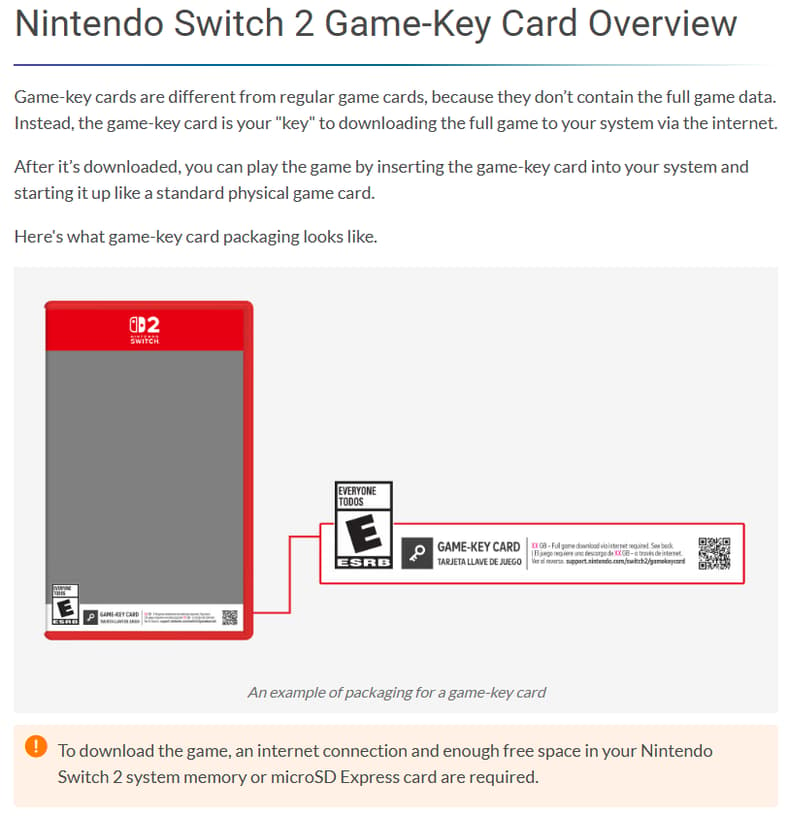
For those unfamiliar, and per Nintendo’s support page, “Game-key cards are different from regular game cards, because they don’t contain the full game data. Instead, the game-key card is your ‘key’ to downloading the full game to your system via the internet.”
“After it’s downloaded, you can play the game by inserting the game-key card into your system and starting it up like a standard physical game card.”
Debates over physical vs. digital aside, the ‘fake physical’ of Game-Key Cards (along with physical boxes with a download code) has been its main criticism for consumers — becoming useless if, or when, Nintendo pulls the servers to verify them.
Hamaguchi isn’t the first to object over the normal Switch 2 cart load speeds. In a discussion earlier this month, over how well Star Wars Outlaws run on Nintendo Switch 2 (via Game-Key Card), Snowdrop game engine audio architect Rob Bantin took to Bluesky to weigh in.
“Snowdrop relies heavily on disk streaming for its open world environments, and we found the Switch 2 cards simply didn’t give the performance we needed at the quality target we were going for. I don’t recall the cost of the cards ever entering the discussion – probably because it was moot,” Bantin denounced.
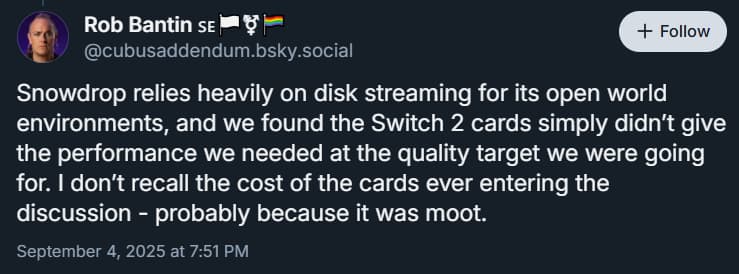
The comment about cost comes from consumer speculation that Game Key-Cards were introduced as a cheaper alternative to physical carts, and that developers were choosing them primarily as a cost-cutting measure.
“I think if we’d designed a game for Switch 2 from the ground up it might have been different. As it was, we’d build a game around the SSDs of the initial target platforms, and then the Switch 2 came along a while later. In this case I think our leadership made the right call,” Bantin praised.
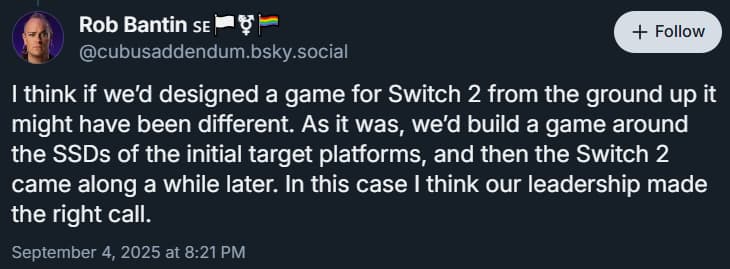
While the Nintendo Switch 2 is more powerful than Nintendo’s consoles typically are — capable of 12 GB of RAM when docked — it still pales in comparison to the remainder of “the big three.” The basic PlayStation 5 model and Xbox Series X both have 16 GB of RAM.
Though developers may be used to Nintendo offering less graphical power, it seems they now have to contend with their games loading slower, or having huge swathes of their game downloaded- digital releases aside.
