
Nintendo Reportedly Using Legally Ambiguous Language To Modify ‘Pokémon’ Patents Amid Ongoing ‘Palworld’ Lawsuit


Nintendo continues to move legal goalposts in their case against Pocketpair, yet again adjusting their Pokémon patents despite the patent infringement case being ongoing. Combined with the language used reportedly being unfitting for a patent, and it appears Nintendo is growing desperate to prove Palworld guilty.

Games Fray reports Nintendo’s latest legal documents have sought to amend their patents in their patent infringement case against Pocketpair and Palworld. It should be noted the date of divisional patents doesn’t matter, but the date of the original patent they are based on; they are subsidiaries designed to further explain a patent.
While completely legal, Nintendo has previously been accused of “lawfare” by adjusting their patents to better apply to Palworld. In response, Pocketpair has removed and adjusted mechanics from the game, causing Nintendo to adjust their patents yet again.

“Corrections 2025-390051” requests for four claims — pertaining a patent for riding a creature, and smoothly switching between them — to be modified. This includes summoning a swimming creature if the player falls into water, and so forth.
The four claims are adjusted across three corrections. The first essentially rephrases that the player can summon a flying creature and immediately begin flying from “the first input” when in mid-air. Correction 3 adjusts “a game program according to any one of Claims 1 to 3,” to “a game program according to Claim 1 or 2.”

Correction 2, at 301 words, explains Claim 1 is about fall damage, and Claim 2 automatically makes the player board a flying creature when they have another selected “even when” other flying creatures can be used.
It should be noted that in Pokémon Legends: Arceus, only one Pokémon can be chosen to fly (Braviary), and other Pokémon games with multiple flying partners use flight more as a quick travel feature, or launch in a different manner (like Latias and Latios in Pokémon Omega Ruby and Alpha Sapphire).

Nonetheless, the corrections were approved by the court, as they do fall under Article 126 of Japan’s Patent Act, which allows patentees to make modifications to their respective written application if they limit themselves to “(i) restriction of the claims”, “(ii) correction of errors or mistranslations” , “(iii) clarification of an ambiguous statement,” and “(iv) rewriting a claim that cites another claim into a claim that does not cite that other claim.”
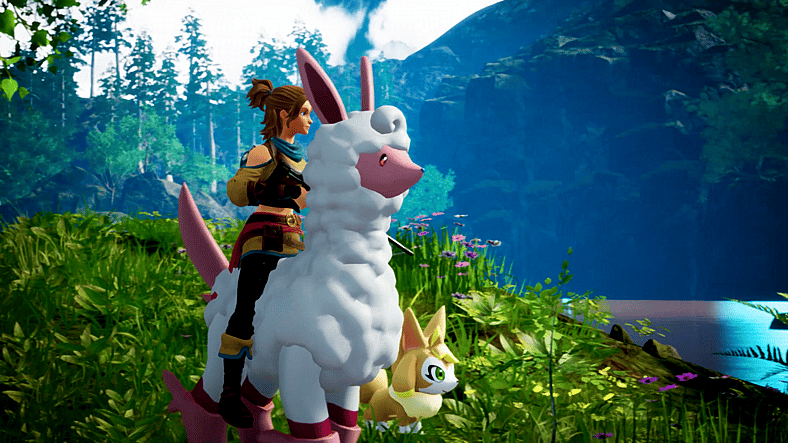
It should be also noted that, per Games Fray, gliding with Pals — currently removed from the game — was first shown in a June 2021 trailer. This was six months prior to the original Nintendo patent application. Even so, Palworld still has Pals that players can ride that truly fly.

RELATED: The 8 Best Cozy Games On Steam (That Aren’t ‘Stardew Valley’)
Licensed attorney Andrew Esquire, Legal Mindset on YouTube, cast his own doubt on Nintendo’s chances. He explained, in a hypothetical US case at least, Pocketpair changing their mechanics would frustrate any “good-faith” infringement claim Nintendo makes- and essential as the US market is “key” to Pocketpair.
Esquire also felt what Nintendo added in the Japanese patents were superfluous “legal gobbledygook,” and also took issue with the use of ambiguous terms like “even when.” While rare to modify a patent mid-litigation, Esquire believed Nintendo intentionally did so as they know “they’re not doing good,” and know their case will struggle.
Should Nintendo lose in Japan, they would lose their Pokémon patents. “So because of that risk, they’re trying to throw out confusion, some ambiguity, some delay” Esquire elaborates. As a litigation tactic, Esquire explains it’s a common tactic with larger companies with deeper pockets to drag litigation out longer than the other side can afford.
Win or lose, this also scares other smaller companies into avoiding legal battles with Nintendo.
Things aren’t doing much better in amended claims in the US, likely building up for a case in the States. The claims explain mounting a flying creature, being able to mount ground-based and swimming creatures, fall damage, displaying miniature “visual objects” representing the flying mounts.

Several claims appear to emphasize the same point again and again — mounting a (sometimes flying) creature from those available and then moving around with it. Some list different ways a player can ride a creature (“dangles from” or “hold on”) — each as their own separate correction. Others are outright redundant, like the phrase “selected based on the selection operation.”
