
Stop Killing Games Founder Responds To Video Games Europe’s Statement Opposing The Movement: “Everything They’re Saying Here Is Their Excuse For Taking Away Your Purchase”


The Video Games Europe lobby — featuring some of gaming’s biggest names — has declared their opposition to the Stop Killing Games movement. The campaign’s founder, Ross Scott, rejected their flawed reasoning and total misunderstanding of the movement’s goals.
As previously reported, the Stop Killing Games EU petition finally reached 1 million signatures (1.3 million at this time of writing). It was arguably brought over the line after creator Ross Scott claimed that coverage by YouTuber Pirate Software misrepresented its goals and caused harm, only for bigger YouTubers to highlight inaccuracies and make a call to arms.
If enough signatures are valid, this means the European Union parliament must discuss making it illegal for a video game company to kill a game — closing official servers the game needs to run without offering any way for gamers to use their own, or for the game to function without servers.
Now Video Games Europe (VGE) — a lobby and publisher group — has announced their stance; rejecting the proposed laws.
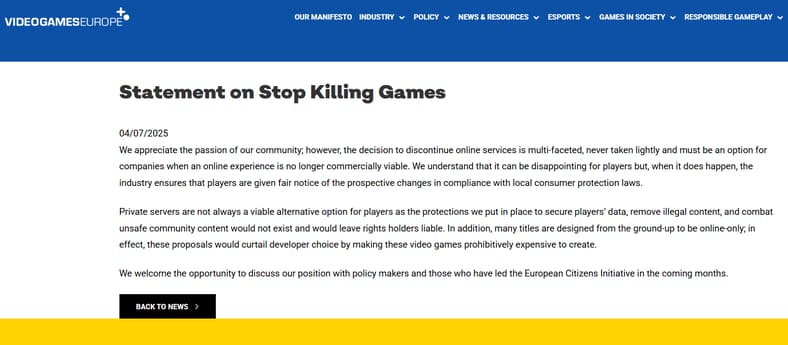
“We appreciate the passion of our community; however, the decision to discontinue online services is multi-faceted, never taken lightly and must be an option for companies when an online experience is no longer commercially viable,” the VGE insisted.
“We understand that it can be disappointing for players but, when it does happen, the industry ensures that players are given fair notice of the prospective changes in compliance with local consumer protection laws.” Scott has previously rejected similar claims, such as the box or purchase page making no warning about some titles eventually becoming completely inoperable.
VGE explains, “Private servers are not always a viable alternative option for players as the protections we put in place to secure players’ data, remove illegal content, and combat unsafe community content would not exist and would leave rights holders liable.”
“In addition, many titles are designed from the ground-up to be online-only; in effect, these proposals would curtail developer choice by making these video games prohibitively expensive to create.” VGE then forewarned, “We welcome the opportunity to discuss our position with policy makers and those who have led the European Citizens Initiative in the coming months.”
In their more detailed position paper, the VGE attempted to explain “Why providing continued support do not [sic] work for all games.” This is despite Scott and the campaign repeatedly stating they don’t want companies shackled to endlessly support a game (wrongfully interpreted by Pirate Software); rather wanting a game able to function even without that support.
“It is not clear what the initiators of the stop killing games petition seek to achieve as a legal change” VGE go on to claim, despite it being explained on the campaign’s website, as well multiple videos by Scott, and several related news articles.
Nonetheless, the VGE’s arguments include the fact all games are licensed (even physical) as part of the games ToS, and “The consumer does not acquire ownership of that video game.” They later infer, “These clear intellectual property rights underpin the entire market and enable the strong investment that the industry has seen for decades. There is no legal uncertainty about the status quo of video games.”
The VGE also balks at the notion of “a requirement to provide a very specific form of end-of-life plan where the game is altered to enable private servers to operate.”
In addition to private servers causing “brand reputation issues” and “eroding” IP rights, releasing the code to run a private server could allegedly place the game’s company at risk of malware, hacking, DDOS attacks, and so-forth. It could even result in “competition” from the “community supported” version of the game over official ones.
The VGE claims there are “significant engineering and architectural challenges” for developers to make a game functional on a private server (requiring “proprietary systems and services”).
It would be a “prohibitive cost,” they argue, further ilustrating, “in some cases years or decades after the game’s initial release when only a small audience remains,” which results in less investments in games, and less jobs. For comparison, Star Wars Battlefront II hit its all-time peak on Steam last month, over five years since it launched on the platform.
This is all in addition to VGE warning third-parties who enabled the game to be playable online forbidding the code being released, and companies being unable to enforce the game’s PEGI rating.

The VGE also insists, “Video game companies are committed to the preservation of games and their cultural value,” and that “members regularly donate game copies and hardware to preservation organisations and support museum exhibitions featuring games.”
Social media did not react kindly to the rejection, especially being VGE’s failure to understand the core argument. Some were quick to highlight what companies made up the lobby’s board and membership; consisting of AAA companies.

These include Microsoft, Nintendo, and Sony Interactive Entertainment; along with Activision Blizzard, Bandai Namco, EA, the Embracer Group, Epic Games, Riot Games, Roblox, Sega, Square Enix, Take Two Interactive, Ubisoft and ZeniMax.
Of note is VGE chairwoman Hester Woodliffe, of Warner Bros. Games, considering MultiVersus was shut down at the start of this year, and the backlash Suicide Squad: Kill the Justice League received over its always online requirement.
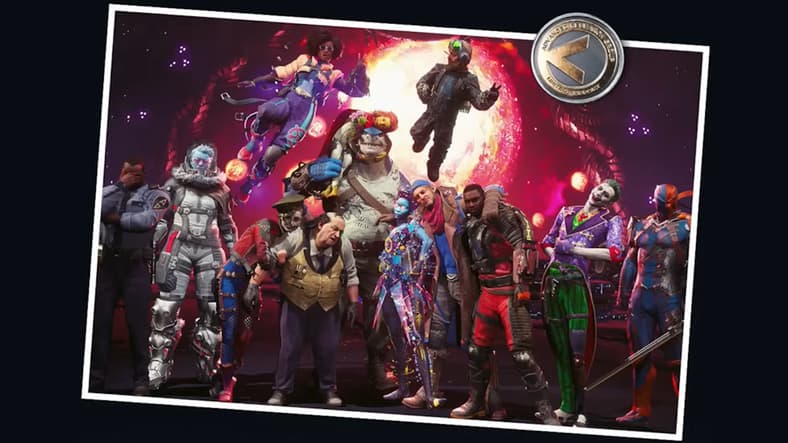
Suicide Squad: Kill the Justice League implemented an offline mode when it was shut down, despite Warner Bros. Games taking a $200 million loss over the game. Ironically, Warner Bros. Games, where VGE’s chairwoman Woodliffe is SVP of Publishing, seems to support Stop Killing Games’ goals, even when making a massive loss — thus proving this is cheaper than keeping it running as the VGE fears.
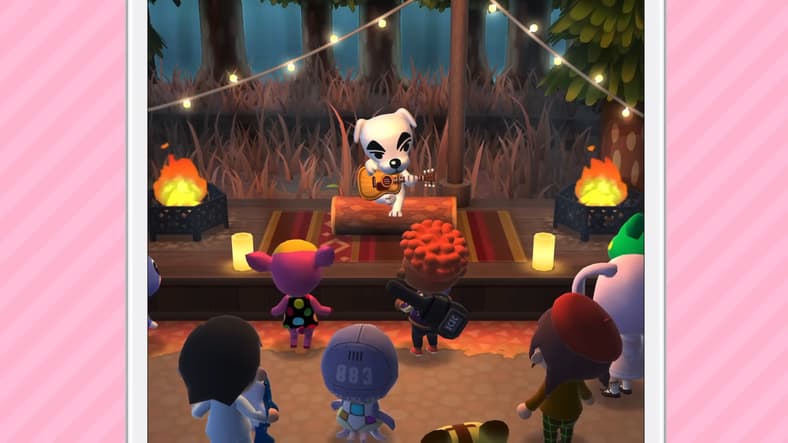
Nintendo (another VGE member) also updated Animal Crossing: Pocket Camp in December last year, removing gacha and online elements to become a paid, offline game with all content in the game — Pocket Camp Complete. At the time, Polygon reported, “Has Nintendo just figured out how to shut down a live game in a good way?”
Scott covered the VGE’s response on his YouTube channel, proud Stop Killing Games had grown in strength. “Do you think if we had chance of changing things, we would have lobbyists coming out against us?”
He wasn’t surprised the “voice of the industry” was against the movement, as shareholders and major companies are “ideologically opposed to us being able to retain our games.” Once again, Scott emphasized that the industry should have the right to shut down a game, responsibly, and with the rights already sold to consumers.
Scott then cites lawyer and YouTuber WBS Legal, who felt Ubisoft didn’t give The Crew players legal fair notice — what should have been two years rather than three months.
RELATED: Tactical SWAT FPS ‘Ready Or Not’ Confirms PC Release Will Feature Console Censorship: “The Game Content Must Be Equal Or Basically Equal For Multiplayer To Work”
On the VGE’s argument against private servers, Scott doubts its impossible to create end-of-life programs. “I think the industry would be surprised how viable it was if the law said you can’t take back the limited license rights you already sold to the customer.
While conceding an unsupported game under consumer control could result in “a rougher and more wild experience” — which Scott knew first had over his Ross’s Game Dungeon covering such games — but nonetheless was not an excuse to “destroy what people paid for,” clarifying, “It just means they’re on their own.”

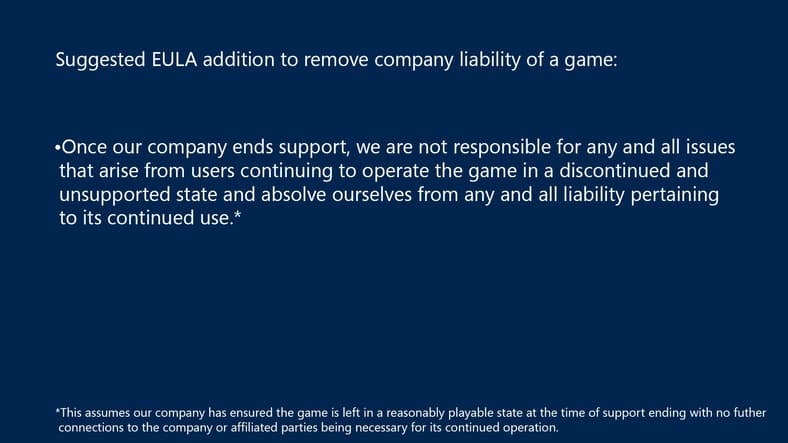
Despite this, Scott feels its “very not true” rights holders would be liable after relinquishing a game; taking it as the industry being incapable of writing an EULA that absolves them of liability after shutdown (despite similar with other products and services). He even suggests an example disclaimer.
“Once our company ends support, we are not responsible for any and all issues that arise from users continuing to operate the game in a discontinued and unsupported state and absolve ourselves from any and all liability pertaining to its continued use,” Scott pitches.
RELATED: ‘Concord’ Alpha Build Leaks Online, Raises Questions About Sony Flop’s Rushed Development
Scott summarized the VGE’s argument as any consumer playing an unlicensed game is a “liability,” and are now taking a “extremely hostile” approach to prevent that happening now they have the technology. Scott again suggests a simple fix — a splash screen that says the game isn’t supported, and the risk is entirely on the consumer.
He mocks the warning that online-only games would become too expensive to make, comparing it to a car company complaining mandatory requirements for seat-belts would become too expensive. More importantly, Scott argues “a whole lot of the complexity and cost of making an online game comes from all the microservices involved. And guess what? We don’t need the vast majority of them for an end-of-life build.”
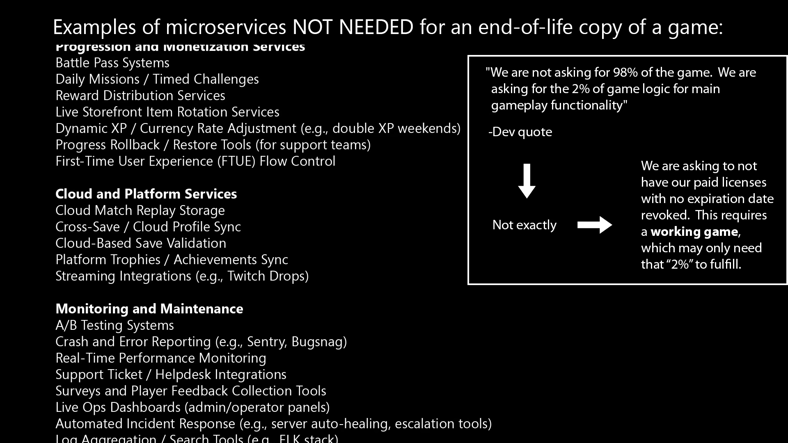
After sharing a list from a game developer of those services not required, Scott quotes them saying, “We are not asking for 98% of the game. We are asking for 2% of the game logic for main gameplay functionality.” Scott then explains even that isn’t what Stop Killing Games is about; rather for paid licenses with no expiration date to not be revoked, and therefore needs a working game (which may only need that 2% to do so).
Scott also highlights Stop Killing Games is not retroactive, and arguments modifying existing games to be able to run privately is null and void.
“Remember, everything they’re saying here is their excuse for taking away your purchase, with no time frame given, and destroying it forever. Is this a good enough excuse for you?” Scott asks. “It isn’t for me. Especially when they’re lying. I think that’s worth taking into consideration.”
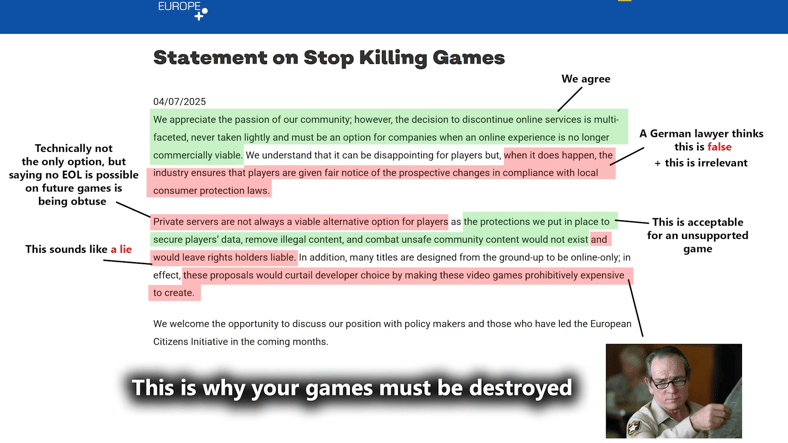
Scott then outright dismisses the longer paper, as it falsely assumes the movement wants infinite support. “I played that song enough already. If I have to explain that a 500th time, I want it to at least be to someone who’s not being paid to undermine us.”
He warns that the VGE will likely be lobbying politicians, but others within the EU can contact their member of parliament, explain the initiative, and ask for their support. This is especially useful for those in the Internal Marker and Consumer Protection Committee, though Scott warns the PfE & ESN are known for not taking action.
